

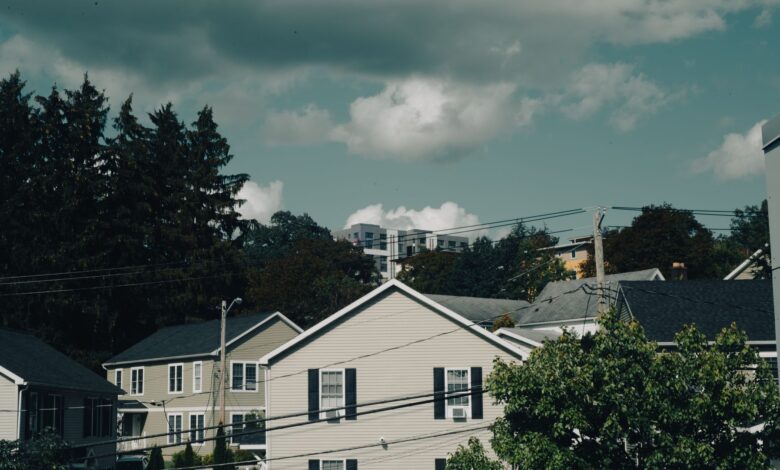
A house on the market is a house someone has decided to give up, and for millions of American owners the cost of giving up has less to do with the home than with the loan attached to it.
How a Low Rate Becomes a Golden Handcuff
The standard American mortgage is a 30-year loan with a rate fixed on day one. That feature is rare worldwide, and it is the root of the problem. When borrowing costs sank to historic lows during the refinance boom of 2020 and 2021, a huge number of households locked in rates near 3 percent, some even lower. Then rates climbed sharply, spending stretches of 2023 near or above 7 percent. Overnight, millions of owners were sitting on a financial asset that no new buyer could get at any price.
Run a simplified version of the math. Take a homeowner with a $300,000 balance at 3 percent: the monthly principal and interest payment comes to roughly $1,265. Borrow the same amount at 7 percent and the payment is close to $2,000. That gap of about $730 a month, every month, for decades, is the real price of moving. It does not appear on any listing sheet or in any agent’s comparison of recent sales, but it shapes the decision more than the sale price does.
The loan also stays behind when the owner leaves. Most conventional mortgages carry a due-on-sale clause, which requires the balance to be paid off when the property changes hands. The buyer cannot simply inherit the old rate. A minority of loans, mainly those backed by the FHA or the VA, can be assumed by a new borrower. Even then, the buyer has to cover the difference between the sale price and the remaining balance, and that difference is often large enough to require a hefty down payment or a second loan at a much higher rate.
Staying put in these circumstances is rational, not stubborn. An owner who would trade a 3 percent loan for a 7 percent one in order to buy a similar house is paying a penalty for nothing. Many simply decide the extra bedroom, the shorter commute or the nicer school district is not worth the penalty.
What Frozen Inventory Does to Everything Else
The most direct effect is on who lists. Owners with a free choice mostly stay, so the homes that do come to market tend to belong to people with no alternative: a job transfer, a divorce, a growing family that has outrun its space, an estate that needs settling. That makes the supply thinner and also less predictable, because it is driven by life events instead of by a healthy flow of owners trading up and down.
Prices are caught between two opposing forces. High rates shrink what buyers can afford, which should push prices lower. But scarce listings mean the few buyers still in the market compete for very little, which props prices up. The result is a market where the usual adjustment mechanism, a falling price, barely operates. What falls instead is volume. Fewer transactions take place, and the people who most want a home are left waiting for a price drop that the inventory shortage keeps postponing.

New construction has filled part of the gap, and builders have advantages that individual sellers lack. A builder can buy down a buyer’s mortgage rate, absorb closing costs or trim square footage to hit a lower price point, all funded from the margin on many homes at once. A private owner has no such tools and cannot offer a below-market loan alongside the keys. That helps explain why new homes have taken a larger share of what is available to buy, even when buyers would otherwise prefer an older house in an established neighborhood.
The housing market works as a chain. A retiree sells a large family house, a growing family buys it, and the family’s starter home goes to a first-time buyer. Each link depends on someone being willing to sell. When one owner decides not to list because of a cheap rate, the break travels down the chain, and a home that would have gone to a younger buyer never appears. Empty nesters stay in houses larger than they need, young families stay in apartments longer than planned, and renters who hoped to buy keep paying rent. A single frozen listing can hold up several households at once.
There is a quieter cost for the broader economy. A worker offered a better job in another city now has to weigh a higher mortgage payment on top of the usual moving expenses, and some will conclude that the raise does not cover the difference. Employers cannot easily measure how many candidates turn down relocations for this reason, but the logic is simple: when moving costs more, fewer people move.
Why the Thaw Is So Slow
Nothing short of a steep drop in mortgage rates would dissolve the lock-in quickly, and even that would not be immediate. Owners compare their current rate against the market, and a gap of one point feels very different from a gap of four. What is more likely is gradual erosion. Life keeps forcing sales, and as time passes, a rate of 6 percent or so stops looking like an aberration and starts looking like the normal cost of borrowing. Every year, more owners reach a point where the reason to move outweighs the rate penalty.
The tension is that relief on rates would release listings and buyers together. If borrowing costs fell enough to coax owners off the sidelines, they would also bring back the many would-be buyers who have been priced out or sitting on their hands, and that extra demand could push prices up just as supply recovers.