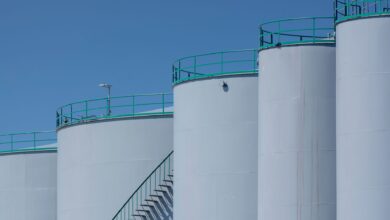
Family Offices Quietly Accumulate Stakes in Asphalt Terminal Throughput Agreements


The Quiet Accumulation Happening Below the Radar
Asphalt terminal throughput agreements are not the kind of asset that makes headlines at investment conferences or gets discussed over cocktails at Davos. They are unglamorous, highly technical contracts that give holders the right to move a specified volume of asphalt through a storage and distribution terminal over a fixed period. And yet, a growing number of family offices – the private wealth management vehicles for ultra-high-net-worth families – are deliberately building positions in these agreements, treating them as a distinct asset class rather than an operational afterthought.
The logic behind this accumulation is less about asphalt itself and more about what throughput agreements represent: locked-in infrastructure access, steady fee income, and a position in the supply chain that is extraordinarily difficult to replicate. While the broader investment world chases data center REITs and AI infrastructure plays, a quieter rotation is happening at the intersection of private capital and physical commodity logistics.

What a Throughput Agreement Actually Is
A throughput agreement is essentially a reservation on infrastructure. The holder commits to moving a minimum volume of product through a terminal – paying a fee whether or not that volume is actually used – in exchange for guaranteed access to storage tanks, loading racks, blending equipment, and port or rail connections. For terminal operators, these agreements provide revenue visibility and justify capital expenditure on new capacity. For the agreement holder, they secure physical access to a bottleneck in the supply chain.
Asphalt, unlike crude oil or natural gas, has a limited number of terminals capable of handling its specific properties. It must be stored at elevated temperatures, requires specialized heating systems, and cannot be moved through standard petroleum infrastructure without modification. That physical constraint creates scarcity value in throughput rights. A family office that holds a long-term throughput agreement at a strategically located terminal – near a major port or highway construction corridor – effectively controls a toll position in the regional supply chain for road-building materials.
The fee structures embedded in these agreements are typically indexed to inflation or tied to volume escalators, which gives holders a natural hedge against rising costs over time. Some agreements include provisions for blending services, which adds another layer of value – the ability to customize asphalt grades for different end-use specifications. That operational optionality makes the agreements more versatile than simple storage contracts, and it is precisely that versatility that appeals to family offices looking for durable, inflation-resistant income streams outside of traditional fixed income.
Why Family Offices, and Why Now
Family offices have been expanding aggressively into real assets over the past several years, driven by the same frustration with public market volatility that has pushed institutional investors toward private credit and infrastructure. What distinguishes family offices from institutional peers is their ability to hold positions indefinitely, without the redemption pressure or quarterly reporting cycles that constrain pension funds and endowments. A throughput agreement with a ten or fifteen year term is not a liability for a family office – it is a feature.
The infrastructure investment wave has largely focused on energy transition assets: solar farms, battery storage, EV charging networks. Asphalt terminals sit conspicuously outside that narrative, which has kept valuations relatively modest and competition among buyers limited. Family offices with experience in traditional energy or logistics have recognized this gap and moved quietly, often acquiring agreements directly from construction companies, road contractors, or midstream operators who would rather monetize the access right than carry it on their balance sheets.

The Investment Case in Detail
The demand side of the asphalt equation is more stable than most commodity markets. Road construction and maintenance spending is driven largely by government budgets – federal highway programs, state infrastructure bonds, municipal maintenance cycles – rather than by private sector sentiment. That gives throughput agreements an indirect linkage to public spending commitments, which tend to be sticky even in economic downturns. When private construction slows, road repair contracts often accelerate as governments deploy counter-cyclical infrastructure spending.
On the supply side, building a new asphalt terminal is a multi-year, capital-intensive process that requires environmental permitting, local zoning approvals, and proximity to either rail or waterway access. The barriers to entry are high enough that existing terminal capacity is unlikely to be meaningfully expanded in most regional markets within a five to seven year horizon. That supply constraint is a structural tailwind for anyone holding an agreement at an existing, well-positioned terminal – it means the access right becomes more valuable over time, not less.
The risk profile is not without complexity. Asphalt demand is sensitive to the price of crude oil, since asphalt is a residual product of petroleum refining, and a prolonged shift toward road surfaces made from recycled or alternative materials could erode long-term demand. There is also counterparty risk: if the terminal operator faces financial distress, the agreement holder may find themselves in a dispute over service continuity. Family offices managing these positions typically conduct detailed diligence on the operator’s financial health and include step-in rights and performance guarantees in the contract structure. This is the same kind of contractual engineering that has become standard in crude oil pipeline capacity rights, where access to physical infrastructure creates value independent of commodity price direction.

What makes the current moment particularly interesting is the concentration of infrastructure spending authorized by recent federal legislation in the United States. Road construction budgets at the state level have expanded meaningfully, and the asphalt needed to resurface aging highway networks has to move through a finite number of terminals. Family offices that secured throughput agreements two or three years ago are now sitting on positions with considerably tighter alternative supply options around them – not because they predicted the policy environment perfectly, but because they understood the physical geography of the supply chain and moved before the investment narrative caught up with the fundamentals. The question now is whether the next wave of buyers will pay a premium to get in, or whether the window for quietly accumulating these positions has already closed in the most competitive markets.